
The Last Linotype Newspaper in America: How Colorado’s Saguache Crescent Still Prints the Old Way
Every week, in a small building on the main street of a southern Colorado town, a man sits down at a machine that casts lines of type in molten lead, assembles them by hand into page forms, and presses ink onto paper. The result is the Saguache Crescent — and as far as anyone in the journalism history field can determine, it is the last newspaper in the United States still produced on a Linotype machine.
What is a linotype newspaper?
A linotype newspaper is produced using a Linotype machine, a mechanical typesetting system that casts entire lines of metal type for printing. Created in the mid-1880s by a German-American clockmaker and inventor named Ottmar Mergenthaler, the Linotypemachine allowed an operator sitting at a keyboard — much like a typewriter — to cast entire lines of type in molten lead at once.
Each keystroke released a small brass mold called a matrix; at the end of a line, the machine automatically justified the spacing, poured in hot metal, and produced a solid “slug” of type ready for the press. Thomas Edison, upon seeing it demonstrated, reportedly called it “the eighth wonder of the world.” The first commercially used Linotype was installed at the New York Tribune in July 1886.
What had taken days now took hours. The Hamilton Wood Type Museum notes that before Mergenthaler’s invention, no newspaper in the world had more than eight pages; the Linotype made the modern newspaper possible. By 1901, 8,000 machines were in use across the United States. By 1954, the figure was 70,000.
Then came phototypesetting in the 1960s, followed by desktop computers in the 1970s and ’80s. The industry moved on almost entirely. The machines were scrapped, melted down, or sent to museums. The specialized knowledge required to operate them — an intricate blend of mechanical intuition, metallurgical care, and typographic craft — faded with the operators who retired or died.
Today, according to newspaper historian Michael S. Sweeney, a professor at the E. W. Scripps School of Journalism who assessed the landscape in 2013, no other American newspaper still uses a Linotype in active production. The Saguache Crescent stands alone.
How the Paper Grew With Its Town
The Crescent‘s origins are inseparable from the roots of Saguache County. Otto Mears, a Russian-born entrepreneur, arrived in Saguache in the mid-1860s. He planted wheat, built a grist mill, opened a general store, and saw that the growing supply town needed a reliable means of attracting settlers and commerce. In 1874, he founded the Saguache Chronicle, the paper’s earliest incarnation.
Through several name changes and ownership transitions across the Gilded Age and Progressive Era — a period during which Saguache’s population briefly swelled to over 600 before the silver crash of the 1890s knocked it back below 400 — the paper survived. It eventually became The Saguache Crescent and has operated from the same building on the town’s main street since 1902.
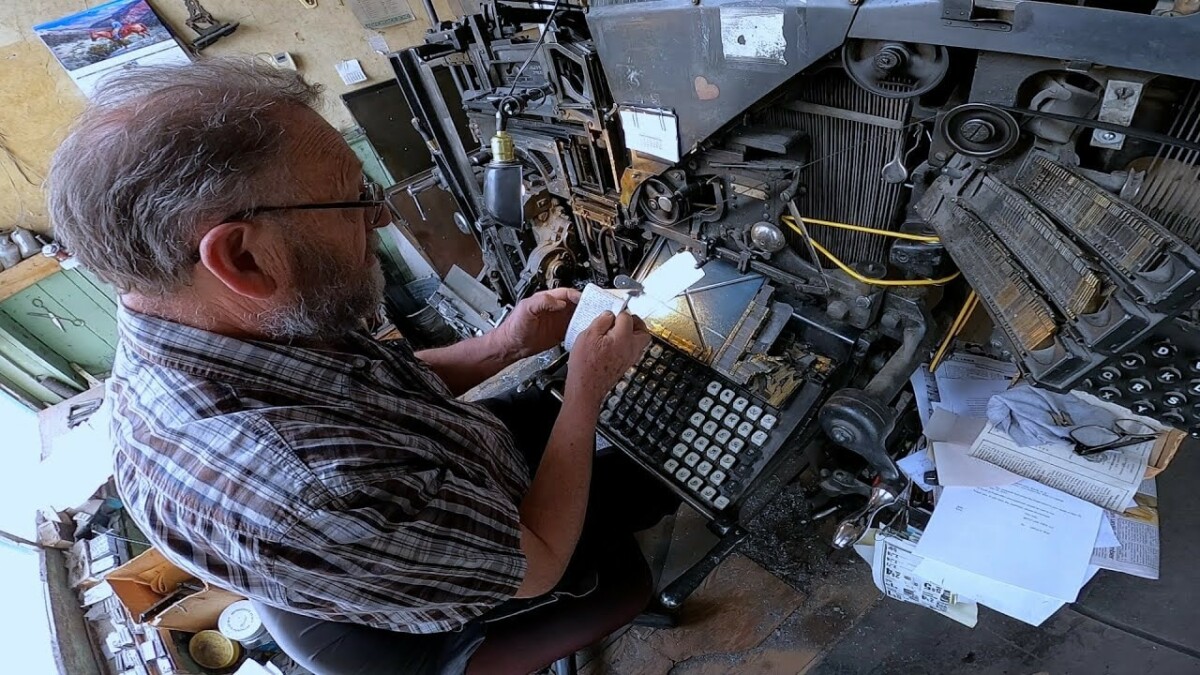
In 1917, the Coombs family purchased the paper. Three generations later, it remains a Coombs operation. The current publisher, Dean Coombs, began working at the paper as a boy, learning the machinery at his mother’s side. When his father Ivan passed away in 1978, Dean took over. He has not missed a single issue in more than four decades of publishing.
“The paper has to come out,” he has said. “It’s just a requirement.”
How the Saguache Crescent is Printed
The Crescent runs on two Mergenthaler Linotype machines, both acquired by the Coombs family in the early decades of their ownership. Dean refers to them, with characteristic plainness, as “Hers” and “His” — nicknames that trace back to his grandparents’ era.
Operating these machines is not a casual undertaking, and the Crescent‘s production process is a reminder of how physically demanding newspaper work used to be.
- Content is gathered from the community. The paper is built around what people in town need to know. Rather than chasing a broad regional audience, it focuses on local material that residents actively bring in or expect to find each week.
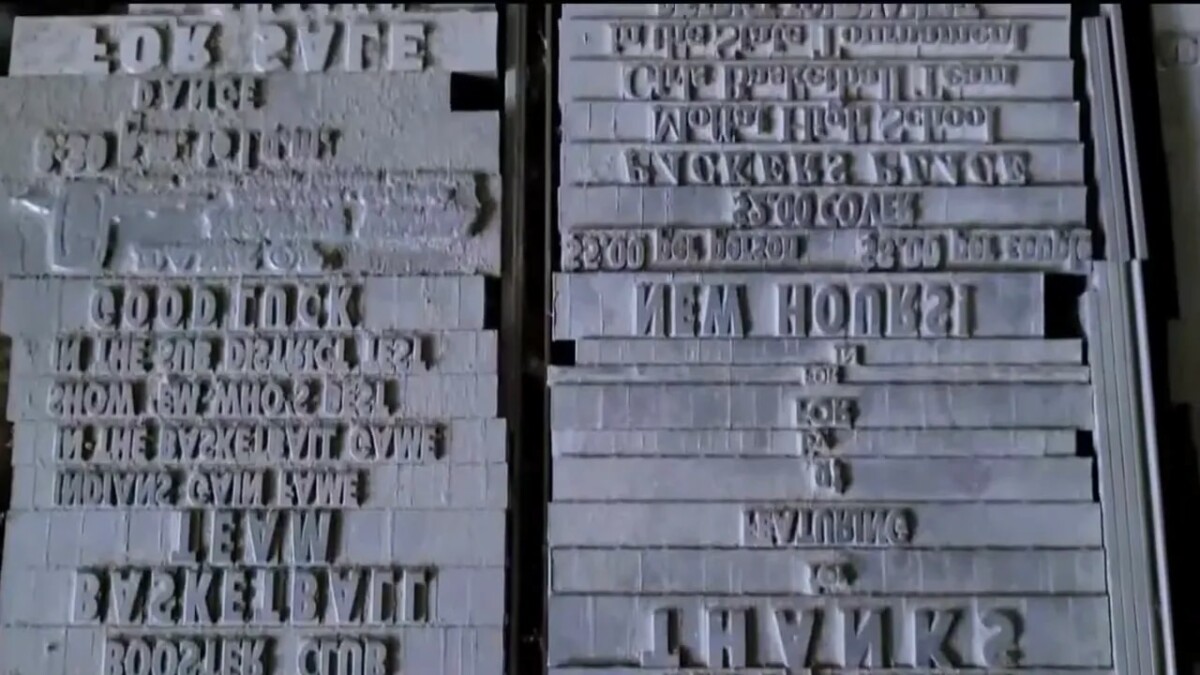
- Type is set on the Linotype machine. The Linotype is a room-filling apparatus of gears, cams, levers, molds, and a small internal furnace that keeps a reservoir of lead alloy molten at all times. The operator types on a 90-key keyboard; the machine automatically justifies each line, pours in hot metal, and ejects a solid slug of type — one line at a time.
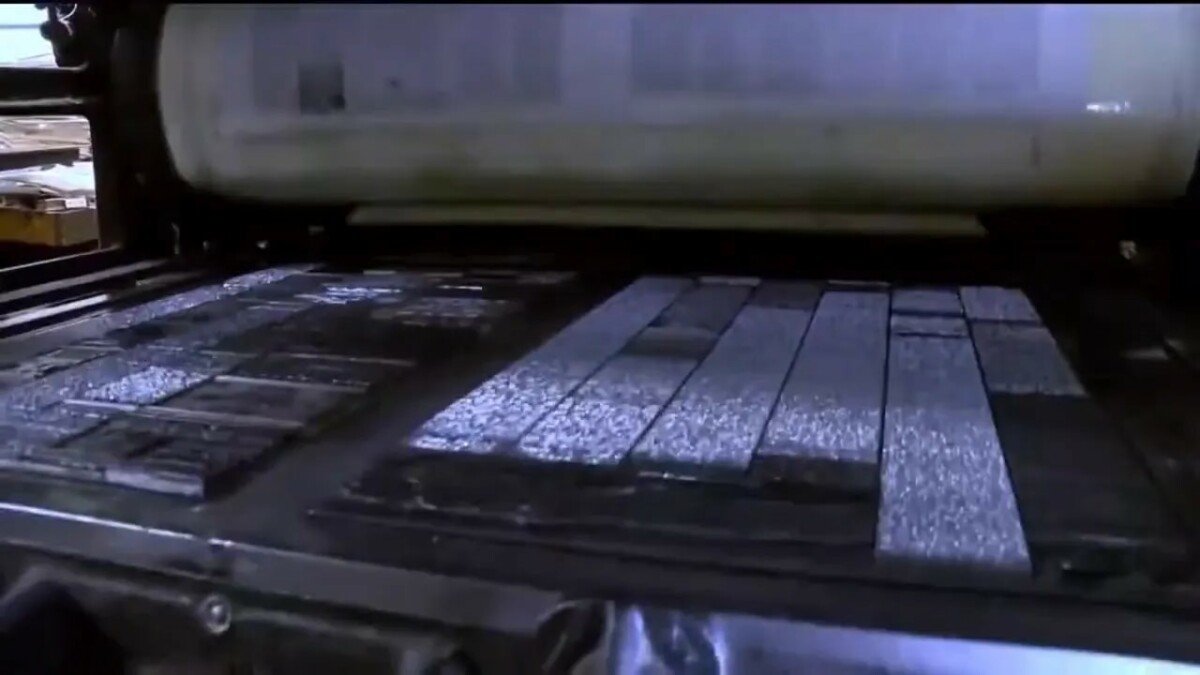
- Metal type is assembled into page forms. The lead slugs are arranged by hand into page-length frames that lock the type in place for printing. The forms are heavy, and every element of every page must be handled with care.
- Pages are printed by letterpress. Ink is rolled across the raised surface of the type and paper is pressed directly against it — a direct mechanical impression that produces the slight debossing and richness of contrast no offset or digital press quite replicates.
- Copies are stacked and prepared for distribution. Even the final step is done by hand, consistent with the physical nature of the entire operation.
Every part of this workflow is demanding. The machinery is temperamental, and an untimely breakdown can mean an all-night repair session with no guarantee of success. Coombs has admitted there are moments when his patience meets its limit — and that it’s wise not to keep a sledgehammer anywhere nearby.
Bill Hazard, a lifelong Saguache resident and retired schoolteacher whose family has been in the valley since the late 1800s, described watching Coombs work with a kind of reverence: “I just marvel at how well he keeps that thing running.”
Why Did Newspapers Stop Using Linotype?
The simple answer is speed and cost. Compared with the technologies that replaced it, Linotype production is slower, more labor-intensive, more mechanically fragile, and dependent on a shrinking pool of people who know how to operate and repair it. When phototypesetting arrived in the 1960s — followed by desktop computers in the 1970s and ’80s — publishers could produce pages faster, cheaper, and with far fewer moving parts. The industry didn’t hesitate. Tens of thousands of machines were scrapped or retired within a generation.
The deeper answer involves what was lost in that transition. Linotype operation is a craft: part typing, part metallurgy, part mechanical repair, accumulated over years of hands-on experience. It cannot be picked up quickly, and it cannot easily be passed on. Once the last generation of trained operators retires, the machines effectively cease to exist as living tools — even if the hardware survives in museums or private collections.
That is precisely what makes the Crescent so unusual. The Crescent managed to outlast every other Linotype newspaper in America partly because it didn’t need to evolve in the same way. Due to Saguache’s smaller population, the paper escaped the pressure to increase production and speed. “The people’s need for change, which is just natural and normal,” Coombs has observed, “I just don’t have that really. So I just go put out the next newspaper.”
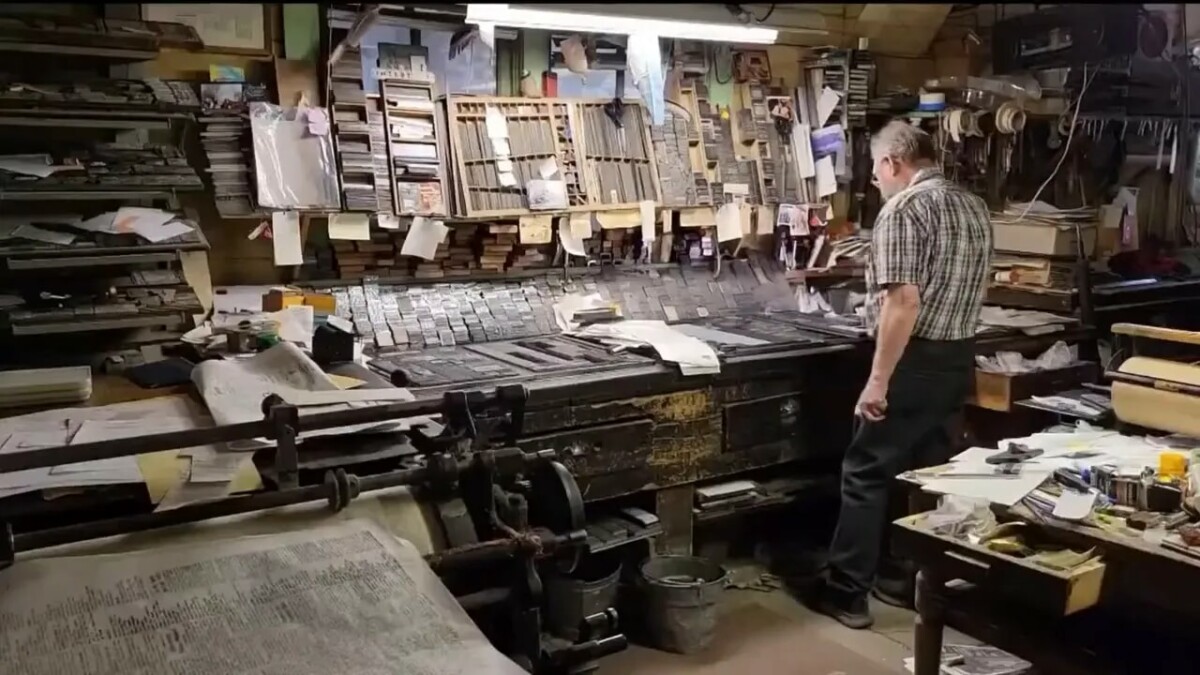
No one knows how much longer the Crescent will continue printing with Linotype — Coombs has no children, and decades of mechanical intuition and craft knowledge are not easily transferred through any conventional training pathway. It is the same challenge facing every institution built around one person’s irreplaceable expertise.
However, for the moment, Coombs and the Saguache Crescent continue to publish weekly, serving its rural community as it has for well over a century. For many residents who lack Internet or computers, it is their lifeline to the rest of the county.
Frequently Asked Questions
Is the Saguache Crescent really the last Linotype newspaper in America?
As far as historians can determine, yes. Newspaper historian Michael S. Sweeney of the E. W. Scripps School of Journalism stated in 2013 that he knew of no other American newspaper still using Linotype in active production. Linotype machines survive in museums and private collections, but the Crescent is the only one still being used to publish a weekly paper.
Where is Saguache, and how do I get there?
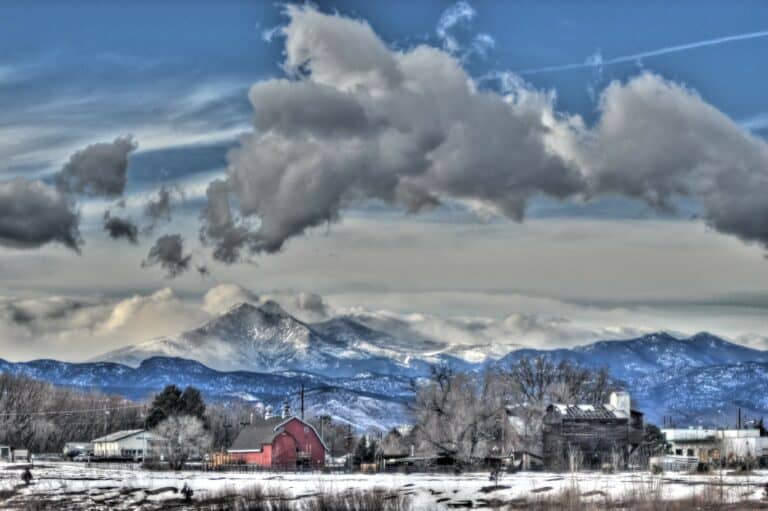
Saguache is in south-central Colorado, at the northern end of the San Luis Valley, roughly 90 miles southwest of Pueblo and about 230 miles from Denver. It sits at 7,700 feet on U.S. Highway 285. The town is also a gateway to Great Sand Dunes National Park, about 45 miles to the south.
What kind of content does the Crescent publish?
Local news in the most practical sense: community meeting notices, county legal publications, obituaries, opinion pieces, volunteer calls, and whatever residents bring through the door. The paper has a long-standing editorial policy — established by Dean Coombs’s mother Marie — of printing only good news.
What is the difference between a Linotype machine and a letterpress?
They are two distinct parts of the same production process. The Linotype is the typesetting machine: it casts lines of type as solid lead slugs using a keyboard-operated mold system. Letterpress is the printing method: those slugs are locked into a frame and inked, and paper is pressed directly against the raised type. The Crescent uses both.
Can I subscribe to the Saguache Crescent?
Yes. The paper publishes weekly and accepts mail subscriptions. Several readers from across the country subscribe specifically because of its unique character and historical significance. Contact the paper at P.O. Box 133, Saguache, CO 81149.
Has the Crescent ever missed an issue?
Not under Dean Coombs’s watch. He has stated that in more than four decades of publishing he has never missed a week — including the week his father died in 1978. “The paper has to come out,” he has said. “It’s just a requirement.”
What happens to the Crescent when Dean Coombs retires?
That is the open question. Coombs has no children, and the specialized knowledge required to operate century-old Linotype machinery does not transfer easily. The paper’s future beyond its current publisher remains uncertain — which makes each issue, in a sense, part of a living archive that may eventually come to an end.