
When’s the Best Time to Water a Lawn in Colorado?
Colorado’s dry climate, high altitude, intense sun, and unpredictable precipitation make lawn care here different from most of the country, especially back east. The best time to water your lawn in Colorado isn’t just a matter of preference — it directly affects how much water your lawn absorbs, how healthy your grass stays, and how much you spend on your water bill. Timing, duration, and frequency all work together: get one wrong and you’re either wasting water or stressing your lawn. In 2026, with Denver Water operating under Stage 1 drought restrictions due to record-low snowpack and below-average reservoir levels, watering smarter matters more than ever. What follows covers the best time of day to water, a season-by-season schedule, efficiency techniques, and current restrictions across the metro.
Why the Best Time to Water Grass Matters in Colorado
Elevation, Sun, and Evaporation
Colorado’s high elevation means stronger UV intensity and significantly faster evaporation rates than lower-altitude states. Water applied during mid-day heat can evaporate before it ever reaches the root zone — wasting the resource entirely while providing little benefit to the grass. Afternoon winds compound the problem: Colorado’s afternoons regularly bring gusts that scatter sprinkler coverage and accelerate surface moisture loss. The result is that when you water and how you water matters as much as how much you apply.
Colorado Soils and Water Absorption
Colorado soils typically run clay-heavy, sandy, or some combination of both — and each creates its own challenge. Clay soil absorbs water slowly, meaning water applied too quickly pools and runs off rather than penetrating to the roots. Sandy soil drains fast, making efficient, targeted delivery essential. Knowing your soil type is the starting point for a watering schedule that actually works — and for understanding why the techniques covered below consistently outperform standard timer-set approaches.
The Best Time of Day to Water Your Colorado Lawn
The best time to water grass in Colorado is early morning, ideally before 10 a.m. Morning watering gives water the best chance to reach the root zone before sun and heat begin driving evaporation. Wind speeds are typically lowest in the early morning hours, which means sprinkler coverage stays on target and drift waste is minimized.
Grass blades that get wet in the morning also dry quickly as the day warms — significantly reducing the risk of fungal disease and lawn disease that thrive when turf stays wet for extended periods. For best results, keep all watering in a single morning session rather than splitting between morning and evening.
Why You Shouldn’t Water During Afternoon or Evening
Afternoon watering during Colorado’s peak sun and wind hours is the least efficient approach available — evaporation rates are at their highest and sprinkler coverage is at its most inconsistent. Evening watering sidesteps evaporation but trades one problem for another: a lawn left wet overnight is exactly the environment fungal growth needs to take hold. Under Denver Water’s Stage 1 drought restrictions, outdoor watering is limited to before 10 a.m. or after 6 p.m. — a rule that aligns practically and agronomically with the morning-first approach.
Colorado Lawn Watering Schedule by Season
Spring — March, April, May
Spring watering should follow precipitation rather than a fixed schedule. Target approximately 1 inch of water per week, watering 1–2 times per week and checking soil moisture before each session — if the ground is still holding moisture from recent rain or snow, skip that cycle.
Under 2026 drought conditions, delay activating sprinkler systems until May and hold off on any new sod or grass seed installation until restrictions ease.
Summer — June, July, August, Early September
Summer is in peak demand. Target approximately 1.5 inches per week across at least two deep watering sessions. Use the Cycle and Soak method — divide each zone’s total runtime into three shorter cycles to allow water to absorb into Colorado’s clay-heavy soils before runoff begins. Instead of one 45-minute session, run three 15-minute cycles with time between each. During the hottest stretches, wet the soil to 4–6 inches per irrigation to build the deep root systems that carry lawns through heat and drought stress.
Early Fall — Mid-September, October
Cooler nights and shorter days reduce lawn water demand naturally. Target 1 inch per week at 1–2 sessions, tapering gradually as temperatures continue to drop. Do not shut off irrigation abruptly — lawns need consistent moisture through October to carry root systems into dormancy in good condition.
Late Fall and Winter — November through February
Winter desiccation is one of the most underestimated sources of lawn damage in Colorado — most damage occurs in January and February when soil is dry and frozen winds pull moisture from turf. Water 1–2 times per month on days when temperatures are above 50°F, applying up to 1 inch per session with a garden hose and sprinkler. Never run an automated sprinkler system during freezing conditions.
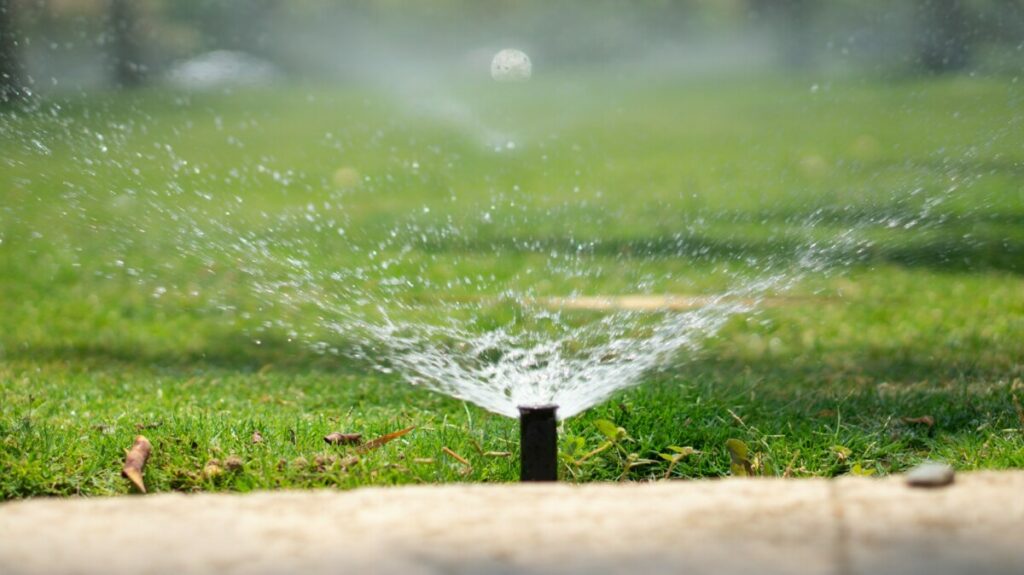
How Long to Water Grass in Colorado
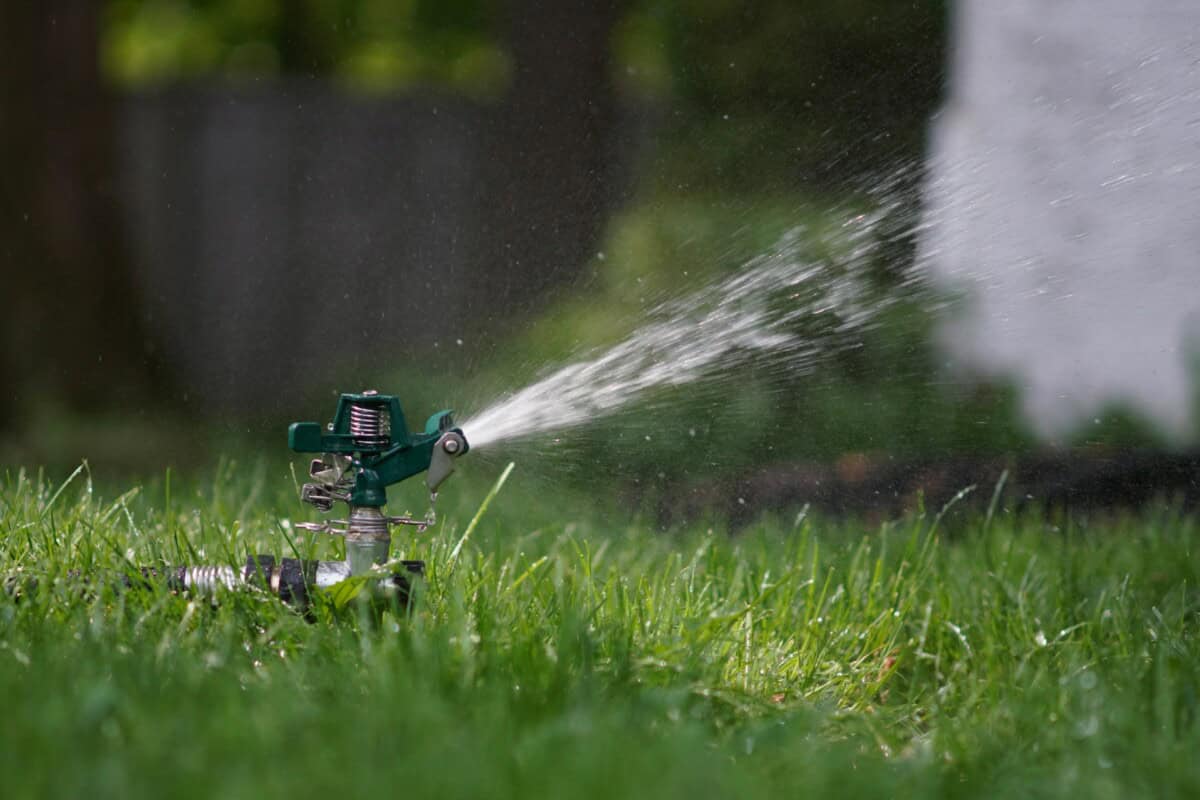
How long to water grass in Colorado depends primarily on the type of sprinkler heads your system uses. General baselines per zone per session:
- Pop-up spray heads: 20–30 minutes
- Rotor heads: 40–50 minutes
- MP Rotator / low-impact heads: longer runtimes required due to lower precipitation rate
These are starting points — not fixed rules. To verify actual output, place a rain gauge or shallow tuna can in the coverage zone and measure how long it takes to collect the target amount. Adjust runtimes based on what you measure, not what the timer assumes.
How Deep the Water Should Reach
The target is 3–5 inches of soil penetration during spring and fall, and 4–6 inches during peak summer heat. Depth is what builds strong, drought-resilient root systems. Shallow, frequent watering produces the opposite — roots that stay near the surface and become more vulnerable to heat stress, drought, and disease with every passing season.
The Cycle and Soak Method Explained
Divide each zone’s total runtime into three equal cycles with absorption time between each. A zone requiring 45 minutes total runs for 15 minutes, pauses to let water absorb, repeats, then completes the final cycle. On clay-heavy Colorado soils, this is the difference between water penetrating to the root zone and water pooling at the surface and running into the street.
3 Tips on How to Water More Efficiently
1. Let the Lawn Tell You When to Water
A fixed schedule is a starting point — soil moisture is the real guide. Before each watering session, insert a stick or probe several inches into the ground. If moist soil adheres when you pull it out, skip that cycle. The lawn itself also communicates: footprint marks that don’t spring back and a blue-gray tint to the grass are reliable signals that water is needed. Waiting for these cues — rather than watering on a rigid timer — is one of the simplest ways to reduce waste without sacrificing lawn health.
2. Smart Sprinkler Controllers and System Audits
Smart sprinkler controllers automatically adjust watering schedules based on real-time weather data, soil type, and plant zone — consistently outperforming fixed-schedule timers on both efficiency and lawn outcomes. Before each season begins, conduct a full sprinkler system audit: check for broken heads, misaligned coverage patterns, and pressure irregularities. A single malfunctioning head can waste hundreds of gallons per week without producing any visible benefit to the lawn.
3. Mulch, Drip, and Watering at the Root Zone
A 2–3 inch layer of organic mulch — straw, leaves, or untreated grass clippings — around garden beds and trees retains soil moisture and can significantly reduce watering frequency. Drip irrigation and soaker hoses deliver water directly to the root zone, cutting evaporative loss dramatically compared to overhead sprinklers. Avoid watering leaves overhead — it wastes water and creates the damp surface conditions that encourage lawn disease.
2026 Drought Restrictions in Place Around Denver, Boulder, & Longmont
What Denver’s Water Stage 1 Drought Restriction Means
Denver Water declared Stage 1 drought effective March 25, 2026, triggered by record-low snowpack and below-average reservoir levels. The Denver lawn watering schedule under current restrictions assigns watering days by address type: even-numbered addresses water on Sunday and Thursday, odd-numbered addresses water on Wednesday and Saturday, and commercial, HOA, and government properties water on Tuesday and Friday.
- Watering hours: Before 10 a.m. or after 6 p.m. only
- Goal: 20% reduction in total water use
- Fines: First offense — warning; second — $250; third — $500
Rules for Outdoor Water Use Across the Metro
The rules for outdoor water use are not uniform across the region — they vary by utility provider, not just county lines:
- Thornton: Stage 1 active since March 15, 2026
- Aurora: Stage 1 effective approximately April 7, 2026
- Consolidated Mutual Water (Jefferson County): 2 days per week, maximum 2 hours per session
- Highlands Ranch (Douglas County): Drought watch — 3 days per week once irrigation season begins
- Longmont: No mandatory restrictions — Drought Watch level. Residents are asked to voluntarily water no more than twice a week, before 10 a.m. or after 6 p.m., and to delay turning on sprinkler systems until May
- Boulder County: No county-wide mandatory rules — restrictions are set individually by water provider, not by county line, so requirements can vary from town to town
Longmont’s stronger position comes down to its water portfolio: Ralph Price Reservoir sat near 79% full in early April, well above the 42-55% of normal seen across Denver Water’s basins. That gives the city more cushion before mandatory watering days would be required — a moderate shortage designation would bring a mandatory three-day-per-week schedule, and a severe designation would move to mandatory two-day-per-week watering with address-based timing.
For more information, review the Longmont Water Advisory Board Meeting – June 2026
Vegetable Gardens and Food Plants Are Treated Differently
Vegetable gardens and food-producing plants are exempt from the same restriction level as turf in all counties with active rules. Hand watering and drip irrigation are permitted as needed in most jurisdictions — the primary requirement is to water outside the 10 a.m. to 6 p.m. window to minimize evaporative loss.
Long-Term Options to Reduce Lawn Water Needs
For homeowners thinking beyond this season, the most impactful step is reducing how much turf needs watering in the first place.
Drought-Tolerant and Xeriscape Plants for Colorado
Converting portions of lawn to xeriscape plants for Colorado is one of the most effective long-term strategies for reducing outdoor water use. ColoradoScape and Water-Wise Yard designs replace water-intensive turf with native grasses, drought-tolerant perennials, and mulched rock beds that require minimal irrigation once established.
Denver Water offers rebates for qualified xeriscape conversions, reducing both upfront installation cost and ongoing water bills. With new lawn installations currently prohibited under Stage 1 restrictions, now is a practical time to explore what a lower-maintenance landscape could look like.
FAQs
What is the best time to water grass in Colorado?
Early morning — before 10 a.m. Evaporation is lowest, wind is calmest, and grass blades dry before nightfall.
How many days a week should I water my lawn in Colorado?
It varies by season: 1–2 times per week in spring and fall, twice weekly minimum in summer, and 1–2 times per month in winter on days above 50°F.
Can I water my lawn during drought restrictions in Denver?
Yes — within your assigned watering days and the approved hours under the current Stage 1 schedule.
What happens if I water on the wrong day under Denver Water restrictions?
First offense is a warning; second is a $250 fine; third is $500.