
What’s the Oldest Brewery in Colorado? Settling the Craft Beer Debate
Have you ever wondered why craft beer is so big in Longmont, the Front Range, and throughout all of Colorado? Local breweries go back much further than most people realize. There’s even a friendly debate over who can claim the title of the oldest brewery in Colorado. From historic taprooms to mountain-inspired recipes, Colorado craft beer has a fascinating history. Let’s dive into that rich history, along with the unique regulations and vibrant culture that have made Colorado breweries so popular.
The Roots of Colorado Brewing: Where It All Began
Colorado’s love of beer didn’t start with the trendy taprooms that dot the Front Range today — it goes back much further to the miners who arrived during the gold rushes and the rugged frontier life of the 1800s, both of which created a profitable market for alcohol.
When gold was discovered in the Rocky Mountains, brewers followed close behind the prospectors. Small-batch beers were sold at mining camps and along access roads to growing communities across the state. Denver itself was officially founded in a humble saloon on Larimer Street.
Rocky Mountain Brewery
Rocky Mountain Brewery, founded in the late 1850s, quickly became the largest brewery between St. Louis and San Francisco, establishing Colorado as a significant brewing state decades before the craft beer movement emerged. However, the brewery didn’t survive long into the next century, so it’s not considered a contender for the “oldest brewery” title.
Coors
A brewery founded by a man named Adolph Coors is our first challenger for Colorado’s oldest brewery, and is certainly the state’s biggest. A German immigrant, Coors arrived in Colorado with $3,000, a business partner, and a recipe for a Czech Pilsner. He settled in Golden, where access to cold Rocky Mountain spring water offered practical advantages for brewing clean, consistent lager.
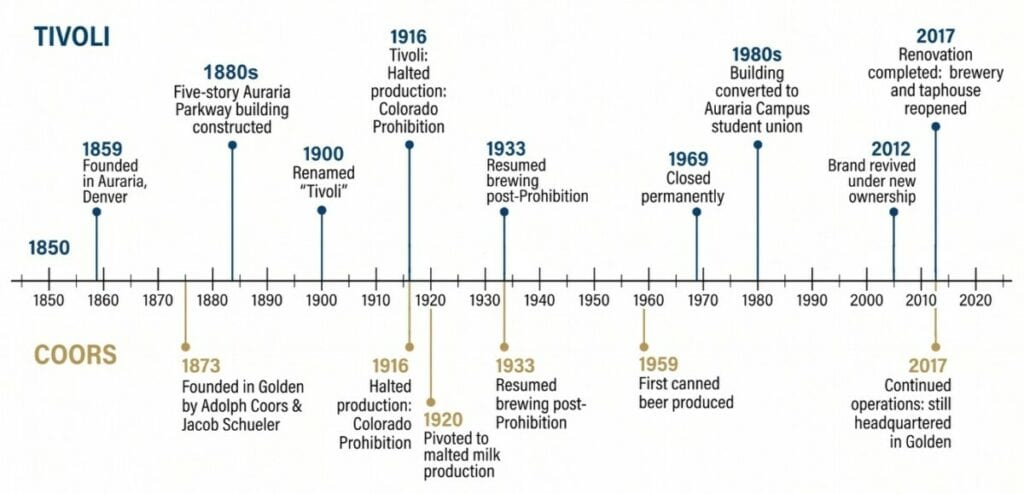
In 1873, Coors and partner Jacob Schueler founded the Golden Brewery in Golden, Colorado — the operation that would eventually become Coors Brewing Company. The brewery grew steadily through the late 1800s and into the early 1900s, built largely on the consistency of its product and reliable access to local water. When Colorado enacted prohibition laws in 1916 — ahead of the Eighteenth Amendment that banned alcohol nationwide — Coors shifted production to malted milk and other products, resuming beer production once prohibition ended.
Over the following decades, Coors expanded from a regional operation into one of Colorado’s largest companies and one of the most widely distributed beer brands in the country. The company remains headquartered in Golden today, on the same Front Range corridor where Adolph Coors first set up operations in the 1870s.
While Coors is undoubtedly the most prominent brewery in Colorado today, it’s not usually considered the oldest. That title belongs to another brewing company: Tivoli.
Tivoli (Generally Recognized as the Oldest Brewery in Colorado)
Tivoli Brewing Company’s origins trace back to 1859 — the same year Denver was founded — when a brewer named John Good established a small operation in the Auraria settlement on the western bank of Cherry Creek. The brewery changed hands several times over the following decades, eventually coming under the ownership of Moritz Sigi, who branded his product “Buck Beer” and built a loyal following among the gold miners and settlers flooding into the region.
By the 1880s, the operation had outgrown its original footprint. A sprawling five-story brick complex was constructed at what is now 900 Auraria Parkway — a building that still stands today. The architecture reflected the brewery’s ambitions: a prominent clock tower, ornate Victorian brickwork, and a scale that signaled permanence in a city that was still finding its footing.
In 1900, the brand was formally renamed “Tivoli” — a reference to the famous Tivoli Gardens in Copenhagen — and the brewery entered its most commercially successful era. Tivoli Beer became a staple across bars throughout the western United States, distributed widely and recognized as one of the most popular regional brands of its time.
Prohibition, Closure, and a Long Dormancy
Colorado enacted statewide prohibition in 1916, ahead of the national ban, and Tivoli — like every brewery in the state — was forced to halt production. The brewery attempted to survive by producing near beer and other non-alcoholic products, but the operation struggled through the prohibition years.
After prohibition ended, Tivoli resumed brewing and managed to regain its footing through the mid-20th century. But the consolidation of the American beer industry in the postwar decades hit regional breweries hard. Unable to compete with the national marketing budgets and distribution networks of Anheuser-Busch and Coors, Tivoli Brewing Company closed in 1969 after more than a century of continuous operation — or near-continuous, accounting for the prohibition interruption.
The building did not sit empty for long after the closure. In the 1980s, a renovation converted the historic structure into a student union for the newly formed Auraria Campus — home to Metropolitan State University of Denver, the University of Colorado Denver, and Community College of Denver. The brewing equipment was removed, the interior was reconfigured, and the building took on an entirely different purpose.
By the early 2010s, however, large portions of the building had fallen into disuse. The 1980s renovation had not aged well, and significant sections sat empty and outdated. The case for returning the building to its original purpose began to take shape.
The Renovation and Return to Brewing
After a 43-year absence, Tivoli Beer began flowing again in 2012 when new ownership revived the brand. To properly re-establish the brewery, the owners undertook a $3.5 million renovation of the historic building, supported in part by $975,000 in State Historic Preservation Tax Credits.
The renovation removed the non-historic additions installed during the 1980s conversion and restored the building’s original interior features. New brewing equipment was installed in the same spaces where Tivoli’s original mash tuns and copper kettles once operated. The project was completed and the renovated brewery and tap house opened in 2017. A tap house by the same name has also opened within the Denver Airport.
Related: Is There Any Truth Behind the Denver Airport Conspiracy Theories?
How Colorado Became the State of Craft Beer
In the late 1970s, federal legislation signed by President Jimmy Carter allowed Americans to brew beer at home for the first time, unlocking a wave of creativity across the country. Colorado moved quickly, with Boulder Beer Company opening its doors around late September — becoming the state’s first craft brewery and the unofficial birthplace of the Colorado craft beer movement.
The Craft Beer Surge — New Belgium, Oskar Blues, and More
The momentum only grew from there:
- Early 1990s — New Belgium Brewing opened, helping spark a regional craft revolution
- Early 2000s — Oskar Blues made history by pioneering craft beer in cans
- Today — well over 300 craft breweries operate across the state
From Coors to celebrated independent names, Colorado’s brewing brands rank among Colorado’s largest companies in the beverage industry — a testament to just how deeply beer is woven into the state’s economic fabric.
The Impact of Independent Liquor Stores
One underrated secret behind Colorado’s craft success? Roughly 1,600 independently owned liquor stores create a powerful distribution network that benefits everyone.
This benefits everyone involved — small breweries gain direct shelf access without competing against corporate giants, local liquor stores see growing foot traffic driven by craft beer demand, and consumers enjoy a wider, more diverse beer selection than they’d find anywhere else.
As Colorado breweries grow, so do the stores that carry them — a symbiotic relationship that other states with grocery store beer sales simply haven’t been able to replicate.
What Makes Colorado Breweries a Must-Visit Experience
History aside, Colorado breweries offer something truly special right now — and locals and visitors alike keep coming back for more.
Colorado’s On-Site Taprooms
Thanks to Colorado’s brewery-friendly regulations, breweries can sell beer directly to consumers on-site without needing a separate liquor license. That means visitors get to enjoy a freshly brewed pint in the same space where it was made — an experience that’s less common than you’d think in other states. Beloved taproom destinations include:
- Oskar Blues in Longmont
- Left Hand Brewing in Longmont
- Denver Beer Company on Platte Street
Community Events That Go Beyond the Pint
Colorado breweries aren’t just places to drink — they’re genuine community hubs. Expect to find:
- Live music and comedy nights
- Trivia nights and outdoor games
- Large-scale festivals like New Belgium’s Tour de Fat — featuring bike parades and live performances
- Cycling events at Oskar Blues, inspired by founder Dale Katechis’s passion for biking
These events transform a simple brewery visit into a full community experience.
Brewery Tours in Colorado
Many Colorado breweries offer guided brewery tours where guests can explore the grounds, watch the brewing process up close, and ask questions — often with a house beer in hand. Top tour destinations include:
- Breckenridge Brewery in Littleton
- Odell Brewery in Fort Collins
- Coors Brewery in Golden
Even without a formal tour, most taprooms keep brewing equipment visible and staff ready to talk shop.
The Colorado Attitude — Sunshine, Outdoors, and Great Beer
Perhaps the greatest ingredient in Colorado’s brewing success is the Colorado lifestyle itself — beer-friendly communities, an outdoor culture, and roughly 300 days of sunshine a year. It’s an environment perfectly designed for cracking open a great craft brew and savoring the moment. With the industry continuing to grow and innovate, the best of Colorado craft beer is still very much ahead.
FAQs
What is the oldest brewery in Colorado?
Tivoli Brewing Company has the strongest claim to the title. Founded in 1859 in Denver’s Auraria neighborhood, the brewery operated under several names and owners before being renamed Tivoli in 1900. It closed in 1969 and sat dormant for over four decades before new ownership revived the brand in 2012 and completed a full restoration of the original building by 2017.
When did craft beer start in Colorado?
The legal foundation came in 1978, when federal legislation signed by President Jimmy Carter allowed Americans to brew beer at home for the first time, opening the door for small commercial breweries and brewpubs. Boulder Beer Company followed shortly after, opening on September 25, 1979 as Colorado’s first craft brewery. Growth was gradual through the 1980s before accelerating significantly in the early 1990s.
How many breweries are in Colorado?
As of the mid-2010s, Colorado had surpassed 300 craft breweries, with new operations continuing to open each year. The number has continued to grow alongside broader industry expansion, making Colorado one of the highest per-capita brewing states in the country.
Can you visit and drink at Colorado breweries?
Yes. Colorado law allows breweries to sell beer directly to consumers on-site without requiring a separate liquor license. This means visitors can purchase and consume beer at the brewery where it is produced — an arrangement that is not universally available in other states and that forms the basis of the taproom model common across the state.
What makes Colorado craft beer different from other states?
Several structural factors contribute. Colorado does not allow full-strength beer sales in grocery stores, which has preserved a network of roughly 1,600 independently owned liquor stores that carry craft products and provide small breweries with direct retail access. The state’s brewery-friendly licensing regulations, combined with a population that has historically supported independent businesses, have created conditions where small and mid-size breweries can sustain distribution without competing directly against national brands for grocery store shelf space.
Is Coors the oldest brewery still operating in Colorado?
Coors Brewing Company, founded in Golden in 1873, is among the oldest continuously operating breweries in the state. Tivoli, founded in 1859, predates Coors by 14 years but operated with significant interruptions — including a full closure from 1969 to 2012. Whether Tivoli or Coors holds the title depends on how continuous operation is defined. Coors has the stronger claim to uninterrupted operation; Tivoli has the earlier founding date.