
Will We Have Enough Water for 2026? Longmont Water & Conservation Report — February 2026
February’s Water Advisory Board meeting covered the basin’s current storage and snowpack conditions, county and district projects to protect supplies and habitat, emergency preparedness at Button Rock Preserve, outreach and conservation programs, and a detailed discussion about how to set the city’s cash‑in‑lieu rate for future water demand.
Table of Contents
- Where the system stands today: flows and reservoirs
- St. Vrain / Left Hand Water Conservancy District: programs and priorities
- Button Rock Preserve: recreation, forestry and wildfire readiness
- Development updates and the fairgrounds replat
- Conservation programs and outreach
- Cash‑in‑lieu (cash and loo): how to set a fair, durable price
- Water supply outlook and what to watch next
- Next meetings and major items on the horizon
- Practical steps for residents and partners
- FAQ
- Closing thoughts
Where the system stands today: flows and reservoirs
Key metrics
- St. Vrain Creek flow that morning was about 13 cfs (historic 125‑year average ~15 cfs).
- Ralph Price Reservoir (Button Rock Preserve) elevation ~6383 and storage ~12,859 acre‑feet (~79% full).
- Union Reservoir gauge ~20 ft (~7,900 acre‑feet), about 62% full.
- Selected basin reservoirs end of January: ~63% of full (very near last year’s 60%).
The short version: storage is not catastrophic but snowpack is well below average. That combination forces careful monitoring through March, April and May when runoff forecasts firm up.
St. Vrain / Left Hand Water Conservancy District: programs and priorities
The district continues to execute a five‑pillar plan: protect water quality, safeguard and conserve supplies, grow local food, store water for dry years and maintain healthy rivers. They prioritize funding partners and projects rather than building a large in‑house staff.
Partner funding program
The board allocates roughly $500,000 per year to local partners for projects that range from mine reclamation and irrigation upgrades to stream restoration and fire mitigation. The goal is a high return on local dollars by leveraging state and federal funds.
Ditch inventory and prefeasibility
A two‑phase ditch program helps ditch companies document infrastructure (phase one) and produces prefeasibility engineering for priority maintenance or capital improvements (phase two). Each phase is budgeted at about $10,000 per ditch and does not require match funding—an important resource for aging ditch systems facing urban pressures and climate stress.
Basin collaborative, fish passage and creek improvements
Work on fish passage, sediment transport and pilot fish salvage demonstrates the district’s focus on functional river systems. In 2024 a pilot fish salvage rescued over 400 fish from a seasonal diversion and returned them to the creek.
Data, technology and weather modification
The district improved data access with a single online dashboard for stream gauges and operational metrics. They are also using airborne LiDAR (laser) to map snow depth and temperature, which improves runoff timing models.
Weather modification remains part of their toolkit (storm seeding stations on both sides of the divide). Early evaluation by independent scientists is underway; preliminary indications are promising but results are not final.
Augmentation program and Copeland Reservoir
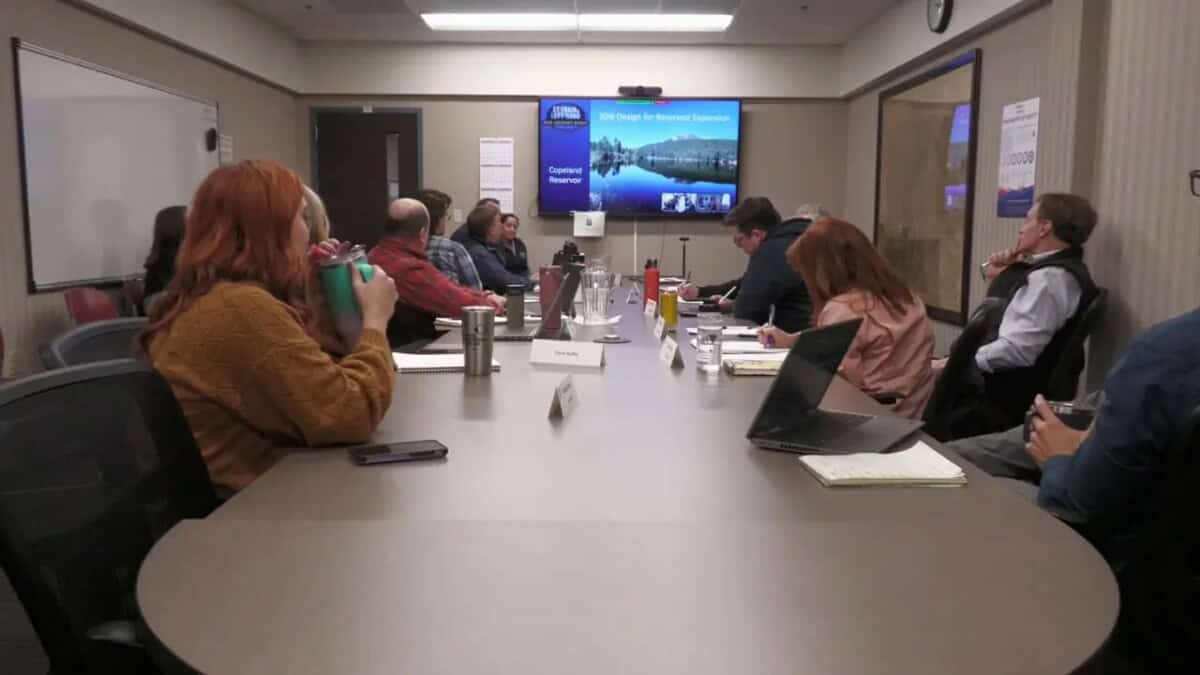
The augmentation program supports roughly 200 members and about 200 acre‑feet of small depletions (pumps, small wells, cabins). The district also owns Copeland Reservoir (inside Rocky Mountain National Park) and is moving to 30% design for a possible expansion—an interesting challenge because the reservoir sits in federal inholding lands.
Button Rock Preserve: recreation, forestry and wildfire readiness
Button Rock is Longmont’s primary drinking water source (about 65% of city supply) and a 30,000‑acre watershed. Staff reported higher wildfire risk this winter due to extremely low snowpack and extended wind events. The preserve’s recent staffing increases (three full‑time rangers plus a grant‑funded forestry technician) improve operations, enforcement and emergency response.
Visitor management and compliance
Visitation has stabilized since the 2023 management changes; compliance has improved. Rangers made several hundred public contacts across the preserve and focused enforcement on violations such as the dog prohibition and closed areas.
Wildfire mitigation and forestry work
Since 2024 the preserve has treated about 1,190 acres and leveraged nearly $1.9 million in grant funding. Cross‑boundary projects with the Forest Service and county agencies have been important. Mechanical thinning, hand crews and some helicopter extraction are used; pile burning is the most effective removal method when conditions permit.
This winter the team has been unable to burn piles because of the low snowpack. Several thousand machine‑created piles remain on the landscape from prior projects and represent both a hazard and an operational headache until they can be safely burned or otherwise removed.
Development updates and the fairgrounds replat
A replat of the Fairgrounds Marketplace site (west of South Hover, north of Home Depot) is moving forward. The project complies with the raw water requirement policy and will subdivide an existing lot into three parcels. A second reading related to a drainage easement vacation is scheduled in the permitting process.
Conservation programs and outreach
The city’s conservation team is ramping up outreach for the year. Highlights include:
- Water Fair — Sunday, June 14; theme this year is Where our water goes.
- Lawn replacement and Garden in a Box — applications open March 9; expanded capacity this year due to CWCB matching grants.
- Rebates — rebates were transitioned in‑house January 1. The city is also part of a Northern Water regional rebate portal pilot with Fort Collins and Loveland to streamline application processing.
- Slow the Flow — irrigation audits and assessments start in June; signups open now.
Cash‑in‑lieu: how to set a fair, durable price
“Cash and loo” (cash‑in‑lieu for raw water) is the payment developers make when historical water rights on a parcel do not meet the city’s raw water requirement. The board discussed options to set that price in a way that is transparent, reproducible and avoids large year‑to‑year swings.
Why this matters
When the cash‑in‑lieu rate lags actual market trends the utility may unintentionally socialize growth costs; when it spikes unpredictably it disrupts development and planning. The goal is a methodology the public and development community can understand.
Methods under consideration
- CBT transaction data — historically useful because CBT is a standardized unit, but the CBT market has thinned and became volatile in earlier cycles.
- Construction cost indices — ties the cash‑in‑lieu adjustment to the price of adding water capacity (storage, transmission, treatment). This is understandable to developers and reflects the cost of delivering operational capacity.
- Consumer Price Index (CPI) — simple but less correlated to water infrastructure costs and to the local development market.
- Commodity or hybrid indices — a blended approach that could incorporate storage levels, water right transactions, construction cost indices and a rolling average to smooth volatility.
- Periodic specialist true‑up — purchase a valuation update from an expert firm (for example, WestWater) every few years to recalibrate the model.
Board direction and near‑term timeline
- Staff will present options in March. The board hopes to refine a recommended methodology by July (or August if scheduling requires) to allow council review and a January 1 effective date.
- Working proposal: a five‑year rolling average tied primarily to a construction cost index, with a specialist true‑up every few years to correct for market anomalies.
- Rationale: construction indices reflect the cost of increasing operational capacity (reservoir enlargement, transmission projects), are understandable to developers, and a five‑year average reduces volatility.
That proposed hybrid balances understandability, fairness, and administrative practicality. Staff will provide specific index candidates and modeled examples at the next meeting.
Water supply outlook and what to watch next
Snowpack is the dominant wild card. Current basin numbers show about ~60% of median snow water equivalent on many measuring sites. Two key takeaways:
- Runoff forecasts in April and May are decisive. A single big spring storm can change the outlook materially.
- Storage remains the city’s primary buffer. Because storage acts like a savings account, Longmont’s reservoir portfolio and storage projects (including recent participation in Chimney Hollow and consideration of Union enlargement) remain critical to resilience.
Northern Water’s April quota decision (based in part on Colorado River and west‑slope conditions) will be important for how much CBT yield the city can expect. Staff believe Longmont has sufficient supply for this year and next under normal operations, but policy choices about conservatism and shortage triggers will depend on April/May data.
Next meetings and major items on the horizon
- March: deeper dive into cash‑in‑lieu methodology and a presentation from Northern Water staff on operations and Chimney Hollow updates.
- April/May: formal water supply and water shortage implementation plan recommendations based on updated runoff forecasts.
- Ongoing: Button Rock forestry projects (rattlesnake Gulch, Northshore treatments) and the regional rebate portal rollout.
Practical steps for residents and partners
- Sign up for lawn replacement and Garden in a Box starting March 9.
- Expect proactive communications from the utility if drought messaging or voluntary reductions become recommended this spring.
- Follow public meetings in March–May if you are a developer or irrigator; those months shape the city’s operational and financial decisions for the year.
FAQ
Is Longmont at risk of running out of water this year?
Longmont currently has enough supply for this year and next under standard operations. The real risk driver is spring runoff. If April and May deliver very low runoff, the city may move toward more conservative operational choices. Staff will recommend actions based on April/May forecasts and Northern Water’s quota decision.
What is cash‑in‑lieu and how will a new rate be chosen?
Cash‑in‑lieu is a payment developers make when an individual parcel lacks the historic water rights required for development. The board is evaluating a method that uses a five‑year rolling average tied to a construction cost index, plus periodic true‑ups by valuation specialists. Final recommendations will go to council for adoption in a timeline that allows a January 1 effective date.
What’s being done at Button Rock to reduce wildfire risk?
Button Rock staff and partners have mechanically treated about 1,190 acres to date, completed cross‑boundary projects with federal and county agencies, and used hand crews and contractors for thinning. Pile burning is the preferred disposal method, but it requires suitable winter snow windows. The preserve is also increasing ranger staffing and emergency response capacity.
How can I access conservation rebates and programs?
Garden in a Box and lawn replacement applications open March 9. The city is part of a regional rebate portal being developed with Northern Water, Fort Collins and Loveland to streamline applications; vendors are being selected now. Check the city’s water conservation web pages for links and sign up details.
How will weather modification and snow seeding impact supplies?
Storm seeding is an operational tool used in select years when conditions are favorable. The district has added west‑slope seeding capacity and commissioned independent scientific evaluation. Early results are promising but not conclusive; seeding is only one of many supply enhancement strategies.
Closing thoughts
This season highlights two enduring truths: storage matters and adaptive policy matters. The city and district are using data, technology and partnerships to protect water quality, reduce wildfire risk, and maintain reliable supplies. The cash‑in‑lieu discussion is a practical, forward‑looking conversation about matching revenue rules to the real cost of providing capacity. Expect more detail and modeled options next month as staff and board refine a recommendable methodology.
If you want to follow the technical updates used in these decisions, keep an eye on the district and utility dashboards, and plan to join the March meeting where the cash‑in‑lieu options and Northern Water briefing will be discussed.